Erlikia-bustoa
Fitxa
-
Izenburua
-
eu
Erlikia-bustoa
-
es
Busto relicario
-
en
Reliquary bust
-
Deskripzioa
-
eu
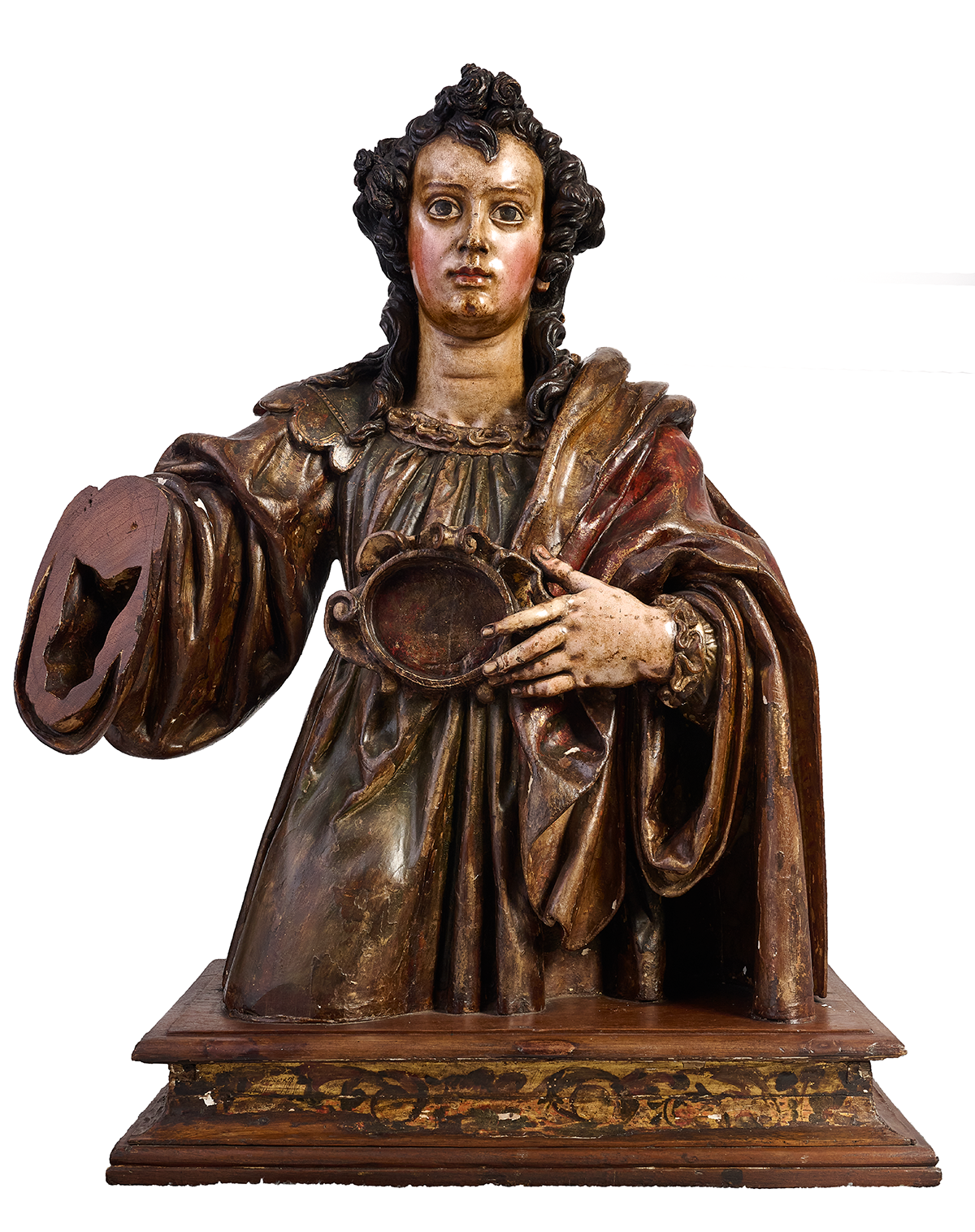
Santa baten gorputz erdiko bustoa, Luzia bezala identikikatu dena, baina baita Maria Magdalena bezala ere. Irudikatutako atributurik ezak zaildu egiten du identifikazio segurua. Aurrez aurre tailatuta dago, begirada horizontean jarrita, eta horrek hieratiko itxura ematen dio. Ilearen tratamendua nabarmendu behar da, aurrealdean eta belarrien gainean irtenguneak eratzen dituzten kizkur kiribilduekin. Kizkur moduan erortzen dira bizkarretik, eta begizta sofistikatu baten bidez biltzen dira. Lepoaren tratamendua Juan de Mesaren obraren antzekoa da. Hori papadan eta erdialdean dagoen arrailduran ikusten da. Olaso dorrearen artxiboan argazki bat dago, oraindik falta zaion eskuarekin (eskuina) eskultura erakusten duena. Ikusten denez, esku horrek kopa bati eusten zion. Gaur egun kontserbatzen den eskuak (ezkerrekoak) erlikia hartuko lukeen erdiko horma-hobiari eusten dio.
-
es
Busto de medio cuerpo de una santa, a la que se ha querido reconocer como Lucía, aunque también como María Magdalena. La falta de atributos representados dificulta una identificación segura. Está tallada de manera frontal, con la mirada puesta en el horizonte, lo que le da un aire hierático. Es de destacar el tratamiento del cabello, a base de rizos ensortijados que forman protuberancias en la parte frontal y sobre las orejas, y que caen en forma de rizos por la espalda, donde son recogidos mediante un sofisticado lazo. Algo característico, y que pone a esta escultura en relación la obra de Juan de Mesa, es el tratamiento del cuello, con papada y una hendidura central en la mitad. Se conserva una fotografía en el archivo de Olaso dorrea que muestra la escultura aún con la mano que ahora le falta (la derecha). Según se aprecia, esta mano sostenía una copa. La mano conservada actualmente (la izquierda) sostiene el nicho central que albergaría la reliquia.
-
en
Half-length bust of a saint, who has been identified as Lucia, although also as Mary Magdalene. The lack of attributes depicted makes a confident identification difficult. She is sculpted frontally, with her gaze fixed on the horizon, giving her a hieratic air. The hair is noteworthy, with coiled curls that form protuberances on the forehead and over the ears, and fall in curls down the back, where they are gathered in a sophisticated bow. A characteristic feature, and one that relates this sculpture to the work of Juan de Mesa, is the treatment of the neck, with a double chin and a central cleft in the middle. A photograph preserved in the Olaso Dorrea archive shows the sculpture still with the currently missing hand (the right one). As can be seen, this hand held a cup. The currently preserved hand (the left one) holds the central niche that would house the relic.
-
Data
-
--
-
Hedadura
-
eu
82 x 70 x 32 zm
-
es
82 x 70 x 32 cm
-
Eskubideen titularra
-
eu
Olaso Dorrea Fundazioa
-
Identifikatzailea
-
ODMU_0092
-
edukia
-
Arte y Artes decorativas

 ODMU_0092.png